Connected buoys: which sensors should be used to monitor water quality?
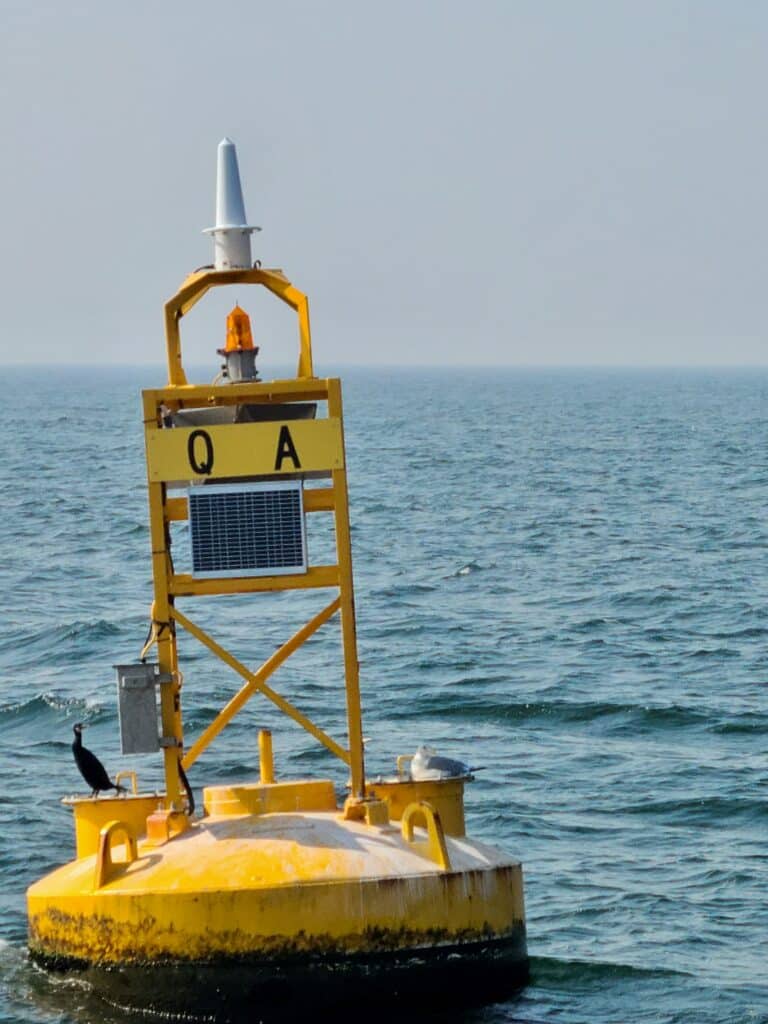
Connected buoys are floating measurement platforms equipped with sensors to monitor water quality directly in the environment. They collect and transmit data such as turbidity, conductivity, salinity and dissolved oxygen, particularly in port areas, lakes and reservoirs, aquaculture facilities and sensitive natural environments.
The choice of instrumentation depends on the phenomenon to be observed, immersion depth, expected autonomy, fouling conditions and the way in which data must be recorded, retrieved or transmitted.
The role of connected buoys in water monitoring
A measurement platform deployed directly in the environment
A connected buoy keeps the instruments at the defined measurement point and, depending on the project configuration, supports the equipment required for remote data transmission. It is suitable when changes in the environment need to be monitored between two field campaigns or when regular access to the monitoring point is difficult.
The sensors remain in contact with the water without requiring a fixed monitoring station to be installed on the shore. The buoy can also be moved when the monitoring programme changes. However, its position must remain consistent with the measurement objective: data collected near the surface do not necessarily describe conditions at mid-depth or near the bottom.
An interface between immersed sensors and the monitoring system
A measurement can be used remotely when the sensor is connected to a module capable of acquiring, timestamping and transmitting the data. The choice of network depends on distance, available coverage, data volume, transmission frequency and the required autonomy. These factors must be defined before deployment, as they influence the choice of module, battery, antenna and maintenance frequency.
In which environments should a connected buoy be deployed?
Coastal waters, ports and marine areas
In coastal and port waters, an instrumented buoy makes it possible to position sensors directly in an area away from the quay or shoreline, such as a harbour entrance, river mouth, construction area or sector affected by freshwater inputs. It provides successive readings at the same point, unlike spot sampling, which only describes the condition of the water at the time of the visit.
Buoys are used in particular to monitor changes in a port area after construction work, observe the effects of a marine discharge, document variations linked to stormwater inputs or compare a harbour entrance with a reference point. When pollution is suspected, the data may indicate a change in the environment, but additional sampling and analysis are still required to identify its nature and origin.
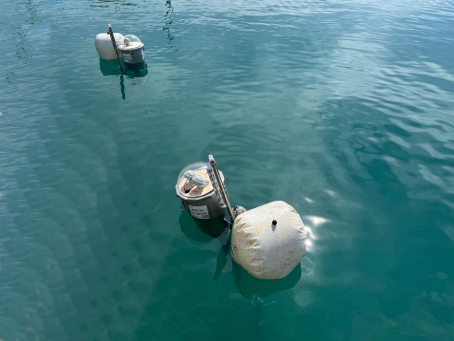
As part of a project carried out in Genoa, an AquaConnect solution was installed to monitor seawater near the mouth of a river in an area affected by coastal construction work. Two measurement points were defined offshore, at a depth of approximately 4 metres, with probes integrated into marine buoys anchored to the seabed. The configuration combined two NTU sensors, one C4E sensor, three antennas and a gateway to transmit data to the offices and monitor variations between river inputs and the construction area.
Lakes, reservoirs and large bodies of water
On a lake or reservoir, an instrumented buoy makes it possible to keep sensors at a point away from the shore, such as the centre of the water body, near a tributary, at a water intake or in a deeper area. Monitoring is therefore no longer limited to areas that are easily accessible from the bank.
Buoys are useful when it is necessary to observe changes in an area after heavy rainfall, monitor the effects of inflow from a watercourse or compare several areas within the same body of water. They are also relevant when conditions vary with depth or when fluctuations in water level make a shore-based installation less representative.
Aquaculture and sensitive natural environments
In an aquaculture facility, an instrumented buoy positions the sensors in the farming area and at the depth selected for monitoring. The data collected complement the checks carried out during site visits and make it easier to observe rapid changes in the environment.
In lagoons, coral reefs or protected natural areas, the buoy can also contribute to monitoring a sensitive location during an algal bloom, suspected pollution event or unusual environmental change.
How should sensors for connected buoys be selected?
Defining monitoring objectives
Sensor selection begins with the question the buoy is intended to answer. Is the aim to monitor an increase in turbidity after construction work? Observe a decrease in oxygen in an aquaculture area? Compare two points within a body of water? Document changes in a coastal area after a discharge or rainfall event?
These objectives guide the choice of parameters, as well as measurement frequency and deployment duration. A temporary campaign does not require the same configuration as continuous monitoring over several months. The expected level of responsiveness must also be defined: regular consultation, alerts, comparison between periods or a simple historical record of the data.
Selecting parameters and measurement points
The choice of measurement point is just as important as the choice of sensor. On a buoy, the position of the probes must therefore be defined according to the phenomenon being monitored: freshwater input, resuspension, farming area, port basin or sensitive sector.
The parameters are then selected according to the information required. Turbidity is used to monitor suspended particles, conductivity provides information on mineral content and mixing between water masses, while dissolved oxygen is particularly useful for monitoring water quality in aquaculture areas, poorly renewed basins or sensitive environments.
Planning deployment and maintenance
Deposits, particles and biological growth can alter a sensor’s measurement surface. Optical systems must retain a clean optical window, while electrode-based probes require regular checks of their active surfaces.
Cleaning frequency depends on the environment and immersion duration. The first maintenance operations help assess the fouling rate at the site and then adjust the intervention schedule. The materials used for probes, cables and connectors must also be compatible with freshwater, seawater and the planned immersion conditions.
Autonomy depends on the entire system: number of probes, measurement frequency, local data logging, data transmission and module wake-up cycles. A high acquisition or transmission frequency increases energy consumption.
Which solutions can be integrated into a buoy?
For turbidity measurement
The NTU sensor can be integrated into a buoy when the project requires turbidity to be monitored directly in the environment. It can be used in particular to observe changes in suspended particles linked to construction work, stormwater inputs, resuspension or local changes in hydrological conditions.
For conductivity and salinity monitoring
The C4E sensor can be integrated into a buoy when monitoring focuses on conductivity, salinity calculated from the measurement, or variations linked to the mixing of water masses. It is particularly relevant in coastal areas, estuaries, ports, reservoirs influenced by inflows or sites where water composition varies according to hydrological conditions.
The sensor must be positioned in an area where water circulates correctly around the measurement surface, so that the data remain representative of the monitored point.
For dissolved oxygen measurement
The OPTOD sensor is suitable for projects where dissolved oxygen must be monitored directly in the water without spot sampling. On a buoy, it can be used in aquaculture, in a poorly renewed port basin, on a body of water or in a sensitive natural area.
AquaMod for data acquisition and transmission
AquaMod is an autonomous LoRaWAN module designed for use with digital sensors. When integrated into a buoy, it collects measurements before transmitting them remotely, according to the communication method selected for the project. On a buoy, its main benefit is that it reduces the number of site visits required to access the data.
Adapting instrumentation to each connected buoy project
A connected buoy must be designed as a complete measurement chain: float, sensors, immersion depth, power supply, acquisition, transmission and maintenance. Sensor selection must be consistent with the monitored environment, installation conditions, expected measurement frequency and opportunities for on-site intervention.
AQUALABO supports engineering consultancies, operators and water-sector stakeholders in selecting digital sensors suited to each instrumented buoy project. Our teams help you identify solutions compatible with your field constraints, whether in freshwater, seawater, port areas, aquaculture facilities or sensitive natural environments.