Which spectrophotometer should you choose for water analysis?
A spectrophotometer measures the amount of light absorbed by a sample at a given wavelength. Common colorimetric methods operate in the visible range. Other analyses use shorter wavelengths in the ultraviolet (UV) range.
The instrument’s spectral range must therefore cover the methods to be performed at the workstation. Other criteria must also be considered: the number of analyses carried out each day, the methods available on the instrument, result storage and the accessories required to perform the analyses.
Key points of the article
- The choice of spectrophotometer depends on the parameters to be analysed and the wavelengths used by the methods.
- For a simple measurement in the visible range, using a method already defined by the user, a PRIM may be sufficient. For routine water quality analyses, UviLine instruments include pre-programmed chemical methods.
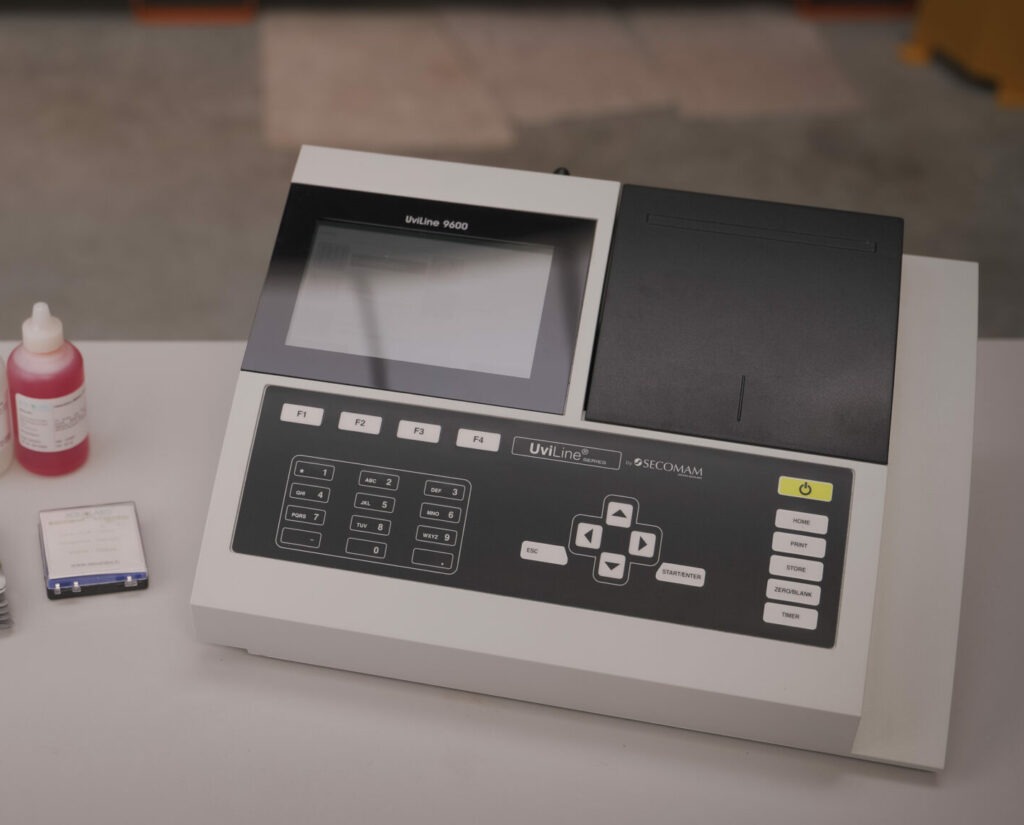
- The UviLine 9300 covers a spectral range from 320 to 1100 nm. When a method requires measurements below 320 nm, the UviLine 9600 extends the range down to 190 nm.
- Reagents, sample preparation, result storage and accessories must also be considered according to the laboratory’s organisation.
What does a spectrophotometer measure?
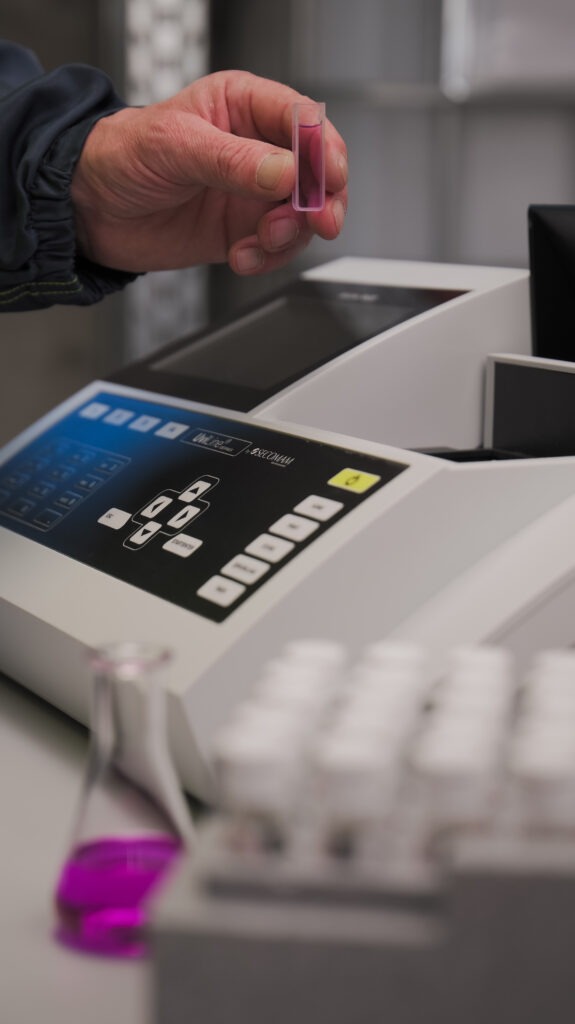
A spectrophotometer passes light through the sample and measures the amount of light absorbed at a defined wavelength. This measurement, known as absorbance, can be used directly or related to the concentration of a compound.
In colorimetric analysis, adding reagents generally produces a colour whose intensity depends on the concentration of the parameter being measured. The spectrophotometer then provides an instrumental reading of this colour rather than relying on visual assessment.
A method can also be developed using standard solutions of known concentrations in order to establish the relationship between absorbance and concentration.
Parameters commonly monitored in this context
In the laboratory, spectrophotometry is used for many chemical water parameters, including chlorine, iron, manganese, phosphates, nitrates, nitrites, ammonium and chemical oxygen demand (COD).
The tube-based methods available for UviLine instruments cover parameters including total nitrogen, ammonium, COD, nitrates, nitrites and phosphates.
Which spectrophotometer should you choose according to the application?
For a simple application in the visible range: a general-purpose spectrophotometer
When a laboratory already knows its method, working wavelength and calibration procedure, a general-purpose visible spectrophotometer may be sufficient.
The PRIM Light and Advanced meet this type of requirement. The PRIM Light can operate in absorbance, transmittance and concentration using a factor or single-point calibration. The PRIM Advanced also includes multi-point calibration, kinetics, multi-wavelength measurements and spectral scanning. Up to 50 user-defined methods can be stored.
The range is mainly used in education. It may also be suitable for certain simple industrial applications when the laboratory already has its own protocol, for example to measure absorbance at a defined wavelength or check the colour of a beverage such as beer or wine.
For routine water analysis: UviLine instruments
For laboratories that regularly analyse several water quality parameters, UviLine instruments are specifically designed for this type of use. They include 86 pre-programmed methods covering 36 parameters, with the associated measurement conditions already stored in the instrument.
The operator selects the parameter to be analysed, prepares the sample using the corresponding reagents and then performs the measurement. The instrument applies the calibration associated with the method to convert absorbance into concentration.
UviLine instruments also feature a colour display, memory for storing results, calculation functions and accessories designed for series of analyses.
UviLine 9300 or UviLine 9600: which spectrophotometer should you choose?
The UviLine 9300 and 9600 share the same operating environment, but differ mainly in their spectral range.
Spectrophotometer | Spectral range | Main application |
UviLine 9300 | 320–1100 nm | Analyses in the visible range, particularly colorimetric methods for water analysis |
UviLine 9600 | 190–1100 nm | Analyses in the visible range + applications requiring measurements in the ultraviolet range |
Both instruments use a reference beam and have a 4 nm bandwidth. The spectral range is therefore the main criterion for choosing between them.
For laboratories carrying out routine analyses, storage capacity is another factor to consider. The UviLine 9300 can store approximately 5,000 individual values, 500 spectra and 400 kinetic curves.
When should you choose the UviLine 9300?
The UviLine 9300 is suitable when the methods remain within the visible range. For a laboratory that regularly analyses several chemical parameters, it provides direct access to the corresponding methods on the instrument.
Its internal memory can store approximately 5,000 individual values, 500 spectra and 400 kinetic curves.
When should you choose the UviLine 9600?
The UviLine 9600 should be selected when a method requires measurements below 320 nm. An analysis performed at 300, 280 or 254 nm therefore falls within its measurement range, which extends down to 190 nm.
Which analyses require a UV-Visible spectrophotometer?
What changes when a measurement is performed in the UV range?
In the visible range, the methods mentioned above generally use a chemical reaction that produces a measurable colour. In the UV range, some applications rely directly on the absorption of light by compounds present in the sample.
The measurement is then performed at the wavelength defined by the protocol. When the laboratory has developed its own method, the measurement conditions and interpretation are defined according to the application.
UV254: a practical example of a UV application
At 254 nm, UV254 measurement is used to monitor the fraction of organic matter that absorbs ultraviolet light. As this wavelength is below 320 nm, an instrument covering the UV range, such as the UviLine 9600, is required.
The principle and interpretation of this measurement are explained in detail in the article on UV254 water monitoring.
What functions do UviLine instruments offer for scientific applications?
In addition to their pre-programmed chemical methods, UviLine instruments can also be used as laboratory spectrophotometers for user-developed applications.
They can notably be used for:
- absorbance and transmittance;
- concentration;
- multi-wavelength measurements;
- spectral scanning;
- kinetics.
A special mode also allows calculations to be performed using customisable mathematical formulas, incorporating additional variables and measurement conditions.
This flexibility means that the same instrument can be used both for existing water analysis methods and for more specific applications developed by the laboratory.
Which reagents and accessories should be used with a spectrophotometer?
Which reagents should be used for water analysis?
The choice of reagents depends on the parameter and the method used.
Several formats are available for UviLine methods:
- liquid reagents supplied in bottles;
- solid reagents in tablet form;
- pre-dosed reagent tubes.
Pre-dosed tubes are notably available for parameters such as COD, total nitrogen, ammonium, nitrates, nitrites and total phosphorus.
They provide some of the reagents required for the analysis in a ready-to-use format and reduce certain preparation steps.
Liquid or solid reagents remain suitable for methods performed regularly when the laboratory prefers to work with refill reagents.
What equipment is required for sample preparation?
Some methods require sample preparation before spectrophotometric measurement.
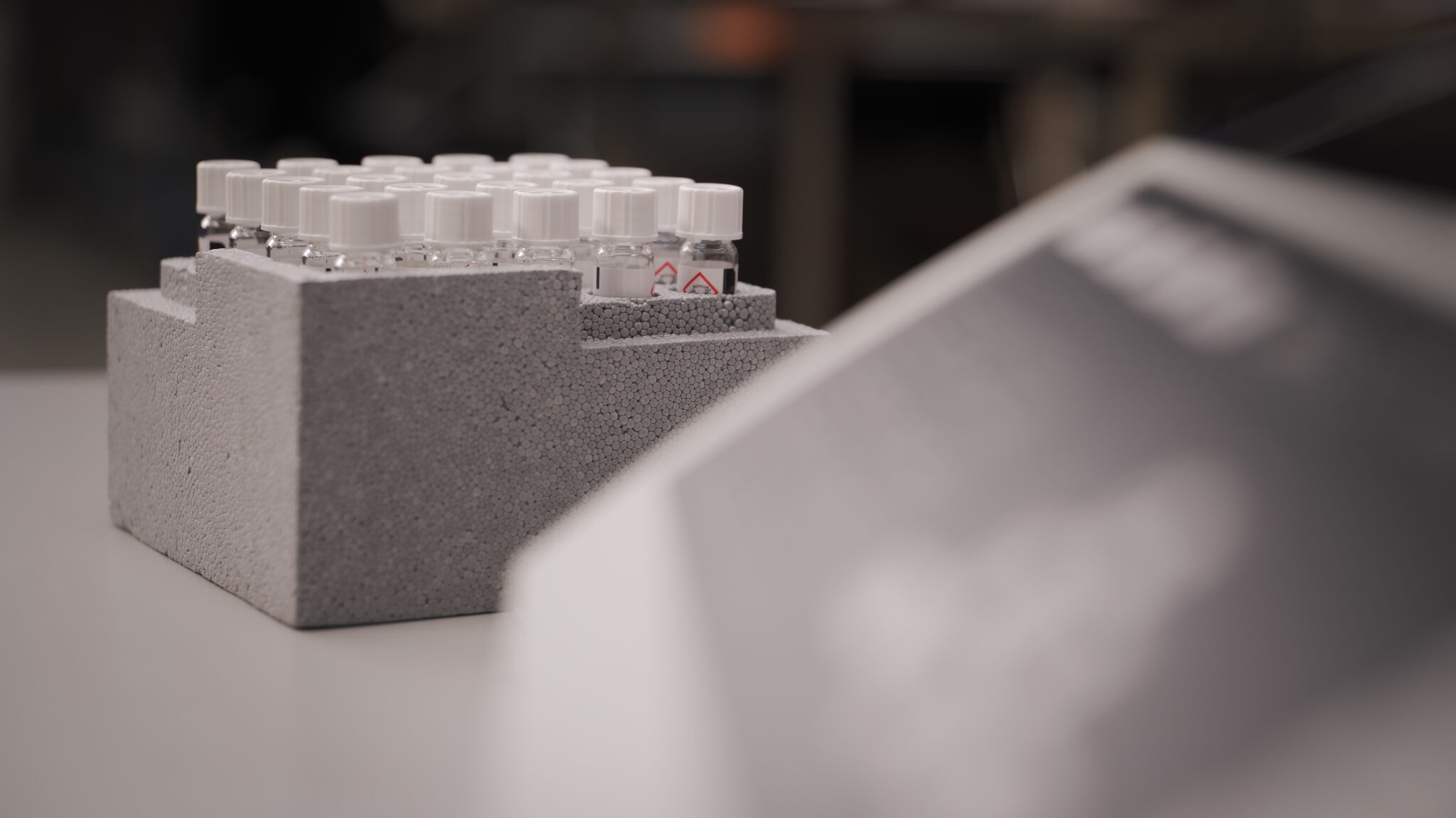
For analyses such as COD, total nitrogen or total phosphorus using pre-dosed tubes, a digestion step may require the use of a heating reactor.
The analysis workstation must also be equipped with the consumables required by the protocol:
- pipettes;
- tube racks;
- tongs;
- cuvettes;
- suitable laboratory glassware.
When a large number of samples are processed, an automatic pipette can also make repetitive handling easier.
How can series of analyses be made easier?
UviLine instruments can be fitted with several accessories designed to automate or simplify analyses.
The Quick-lock system can notably accommodate:
- a 5+1 automatic cuvette changer;
- a Sipper, allowing sample aspiration;
- a universal cuvette holder;
- a Peltier-thermostatted cuvette holder.
These accessories are particularly useful when the laboratory processes large series of samples or when measurement conditions need to be more tightly controlled.
Choosing a spectrophotometer suited to the laboratory’s analyses
For an occasional measurement using an already defined protocol, a general-purpose visible spectrophotometer may be sufficient. Laboratories that regularly carry out water analyses may prefer the pre-programmed methods available on UviLine instruments, selecting the spectral range according to the intended applications.
In France and internationally, Aqualabo teams advise laboratories, operators and industrial companies on the selection of spectrophotometers, reagents and accessories suited to the analytical methods they use.
Do you have an equipment project or are you looking to upgrade your analytical instruments? Contact our teams to discuss your requirements.