Multiparameter water analyser: what are the benefits for your installations?

Going beyond a single measurement for water quality control
In treatment facilities, networks, basins, or industrial circuits, water quality is never captured by a single measurement. An isolated data point can be difficult to interpret without context. By contrast, several parameters recorded at the same time provide a more structured reading. This approach is valuable when teams need to compare monitoring campaigns, justify an intervention, or track changes over time.
A multiparameter analyser designed for water applications combines several physico-chemical measurements within a single device, with centralised readout. For operations and maintenance teams, this organisation makes data more consistent and easier to use in the field.
Meeting traceability and compliance requirements
Traceability requirements have tightened across most water-related sectors. A drinking water network operator must be able to present a consistent record of measurements to the regional health authority. A wastewater treatment plant manager must document the quality of effluents prior to discharge. A technician working on a site certified to ISO standards or subject to a HACCP plan must be able to timestamp measurements and identify the sensor used.
A value without context quickly becomes unreadable, impossible to compare across campaigns, difficult to pass on to another operator, or unusable in an audit report. A multiparameter analyser centralises this information, making data immediately usable over time.
The limitations of spot checks and isolated measurements
Spot checks remain an important part of field practice. They are well suited to quick verifications, targeted diagnostics, and maintenance interventions. They deliver an effective operational response, particularly when a technician needs to inspect a specific point or confirm a situation on site.
However, when several parameters need to be cross-referenced or compared over time, isolated measurements generate additional work: manual re-entry, consolidation of readings from multiple instruments, and the risk of transcription errors between two interventions. On a site where three technicians work in rotation with different equipment, data consistency becomes difficult to guarantee without a common framework. It is precisely in these situations that the multiparameter approach provides a more structured organisation.

Multiparameter analyser: principle and operation
Measuring several physico-chemical parameters in a single analysis
A multiparameter analyser combines, within a single architecture, multiple measurement channels designed to monitor different physico-chemical parameters of water. Each parameter relies on a dedicated sensor and a specific measurement technology.
Depending on the configuration, the instrument can handle pH, dissolved oxygen, conductivity, salinity, temperature, turbidity, total suspended solids (TSS), ORP (oxidation-reduction potential), and sludge blanket level. Some instruments can also be paired with a photometer to extend the range of available analyses.
Differences between portable instruments, probes, and online systems
A portable multiparameter instrument is designed for spot interventions, monitoring campaigns, rapid diagnostics, and on-site verifications. A multiparameter probe is intended for in situ measurements, directly in the medium or in a basin, without intermediate sampling. An online system is installed as a fixed unit for continuous monitoring, connected to the installation and to a supervisory workstation.
The choice therefore depends on the monitoring frequency, the mode of operation, and the level of integration expected within the process or technical infrastructure.

Why adopt multiparameter measurement in your installations?
Reducing measurement time and field interventions
When a technician needs to inspect several points in a single day, the time spent on measurements directly affects the organisation of interventions. A multiparameter device eliminates the need for multiple instruments, simplifies handling, and allows readings to be taken more quickly, whether on a network, a basin, or process water. Site rounds become more efficient, and the professional can focus more on interpreting results and verifying the points inspected.
Improving data consistency and reliability
When several parameters are measured with the same instrument, at the same point, and at the same time, results become more comparable. This consistency is particularly useful for teams that need to cross-reference measurements between two dates, across multiple sites, or between different phases of operation. Discrepancies caused by instrument changes or scattered manual records are better controlled as a result.
Repeatability is also improved when campaigns are conducted with the same configuration, which makes it easier to compare data over time.
Facilitating installation monitoring and drift detection
A drift is not always expressed through a single value. In many contexts, it is the simultaneous change across several parameters that makes it possible to identify an anomaly. A drop in dissolved oxygen combined with a rise in temperature, or concurrent variations in turbidity, conductivity, or pH, provide a more accurate picture of the situation. This overall view makes it easier for operations teams to identify drifts and interpret them correctly.
Integrating multiparameter analysis by sector

Drinking water and local authorities: network monitoring and compliance
In drinking water supply and municipal contexts, multiparameter analysis addresses needs for field control, network monitoring, and verification on water resources or structures. Teams need clear data to examine a situation, compare several points, or complete a monitoring campaign. Centralising parameters on a single instrument simplifies readings and structures interventions more effectively. In these contexts, a portable multiparameter analyser can be used during spot diagnostics or inspection rounds.

Wastewater treatment plants and industrial discharges: treatment management
In wastewater treatment plants and for industrial discharges, several parameters often need to be monitored at distinct control points, according to treatment stages. Technicians and process managers need a consistent reading of the data to understand how a structure is evolving, monitor its operation, or analyse a drift.
A transmitter such as the ACTEON 5000 can be connected to various sensors and integrated into a supervisory architecture. Depending on the application, it can also be paired with specific technologies such as the STACSENSE probe for correlations related to COD, BOD, or COT.

Aquaculture: monitoring biological equilibria
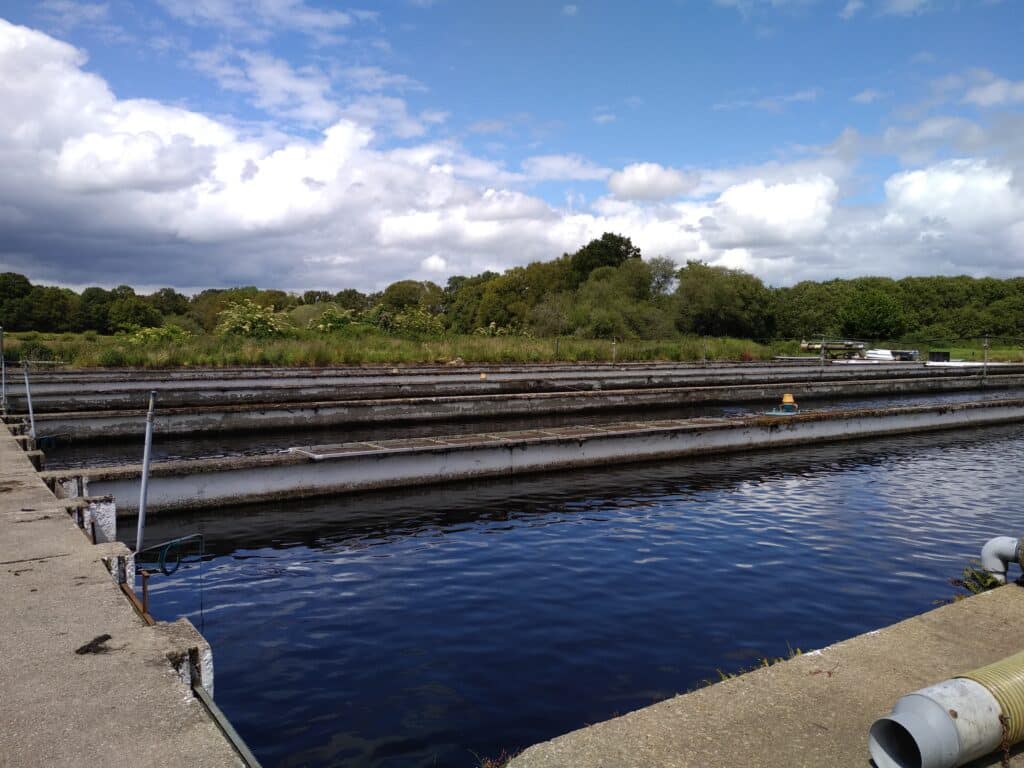
In aquaculture, several physico-chemical parameters directly influence the living conditions of fish. Dissolved oxygen, temperature, pH, and salinity must be observed together to obtain a consistent picture of the basin or circuit. An isolated measurement provides only partial information if it is not placed within the full set of equilibria observed at the same time.
A multiparameter probe can be deployed directly in the water, enabling in situ measurement without intermediate sampling. This configuration is suited to basins, ponds, fish farming installations, and any installation requiring direct and continuous measurement.
Energy industry: preventing drift in circuits
In the energy industry, water quality directly determines equipment service life. On a cooling circuit, an undetected conductivity drift promotes corrosion of heat exchangers. A pH variation in a closed circuit accelerates scaling and degrades thermal performance. A portable multiparameter instrument makes it possible to record conductivity, pH, and temperature across multiple points on the same circuit in a single round. When the site requires continuous monitoring, an online transmitter takes over. In both cases, data consistency across campaigns helps teams detect a trend before it becomes an incident.
Which type of multiparameter analyser suits your application?
Field control: the portable instrument
For spot interventions, monitoring campaigns, and on-site verifications, the portable multiparameter instrument is a solution directly suited to field use. Aqualabo’s ODEON and NEON Open multiparameter solutions are compatible with DIGISENS digital sensors and meet these operational needs.
The NEON Open can measure dissolved oxygen, pH, conductivity, salinity, turbidity, TSS, sludge blanket level, and temperature. It can record up to 30,000 measurement points and transfer data via WiFi.
ODEON, for its part, stands out for its memory capacity of up to 100,000 data points, its extended battery life, and its compatibility with a digital photometer covering more than 40 additional parameters.
Submerged measurement: the probe for in situ monitoring
When measurement must be taken directly in the medium, the multiparameter probe offers an appropriate solution. Aqualabo’s Tripod probe can be used inline or as a fixed installation and can accommodate up to three sensors to monitor parameters such as pH, ORP, temperature, dissolved oxygen, turbidity, conductivity, salinity, and TDS (total dissolved solids).
This configuration adapts to a wide range of contexts: aquaculture, environmental monitoring, networks, water resources, and basins. It enables direct measurement in the medium, without sampling, under real conditions. The durability of the sensors and the integration of digital technologies support extended field use, including in hard-to-access areas or where battery autonomy is a determining factor.
Continuous monitoring: the online transmitter
For installation management, the multiparameter transmitter is designed for sites that require continuous monitoring. Aqualabo’s ACTEON 5000 has been developed for both indoor and outdoor use. Compatible with a wide range of analogue and digital sensors, it features Modbus and Ethernet outputs for integration into a supervisory environment.
This type of equipment can display several measurements simultaneously, centralise data, and automate record traceability. In applications where water quality must be monitored continuously, this configuration provides a more stable reading of observed trends. It is suited to operators who wish to link water quality analysis directly to the overall operation of their installation.
A comprehensive view for managing your analyses
Choosing a multiparameter water analyser enables water quality analysis and control to be approached with an overall picture that is directly usable in the field. By combining several parameters at the same time, teams have consistent data to interpret a situation, compare results, and identify a drift more quickly.
Aqualabo equipment is designed and manufactured in France, deployed across 5 continents, and certified ISO 9001. Our teams can support you in selecting the solution best suited to your installation and your requirements.
For spot field checks, discover our reagent test kits.
Contact our teams for advice on your installation.