How to test iron in water circuits?
Testing iron in water circuit consists of measuring the ferrous and ferric ions present in the sample in order to detect degradation of metallic materials or an external input. The result is expressed in milligrams per litre (mg/L) and must be interpreted according to the installation being monitored.
This analysis applies in particular to closed heating circuits, cooling towers, technical networks and certain types of process water. It can be carried out directly on site using a colorimetric kit, or with a spectrophotometer when the operator requires an instrumented reading and results that can be compared over time. This article presents the situations in which testing should be carried out, the methods available and the checks to consider after measurement.
What does the presence of iron in a circuit reveal?
An indicator of material corrosion
In an installation containing steel or cast iron, the iron measured in the water may come from the deterioration of metallic surfaces. The products formed may remain dissolved, circulate with the water or settle in pipes, filters and heat exchangers.
The result only describes the iron present in the analysed sample. It does not necessarily represent the total amount accumulated in the installation. A circuit may contain significant deposits while the sampled water shows a low concentration. Conversely, a high value may correspond to particles recently resuspended after an intervention or a change in flow rate.
The measurement must therefore be related to the observed condition of the circuit: coloured water, sludge, deposits, clogging or recent changes in operation.
Information to interpret according to the type of circuit
The same concentration does not necessarily have the same origin or significance in every installation. In a recently commissioned circuit, the result must be interpreted taking into account the network materials, the effectiveness of the flushing carried out before filling and the quality of the water used to fill the installation. In an older installation, it must also be placed in the context of make-up water history and maintenance operations.
In a cooling tower, water is more exposed to air exchange and concentration phenomena linked to circuit operation. In a distribution network or process water system, iron may also come from the feed water or from an upstream section. The sampling point then becomes decisive in locating the origin of the variation.
Why iron alone is not sufficient to establish a diagnosis
The presence of iron indicates that a phenomenon should be examined, but it does not, on its own, specify its origin or intensity. A high value may be linked to ongoing corrosion, resuspension of existing deposits, recent works or contamination of the sample during sampling.
Interpretation generally requires iron to be compared with other available information: pH, conductivity, dissolved oxygen, appearance of the water, presence of deposits, frequency of make-up water additions or condition of the filters. The materials in the network and the treatment applied must also be known.
A high value is therefore an element for investigation. Without further checks, it does not allow active corrosion on a specific piece of equipment to be confirmed.
How can the presence of iron be tested quickly?
Rapid on-site testing
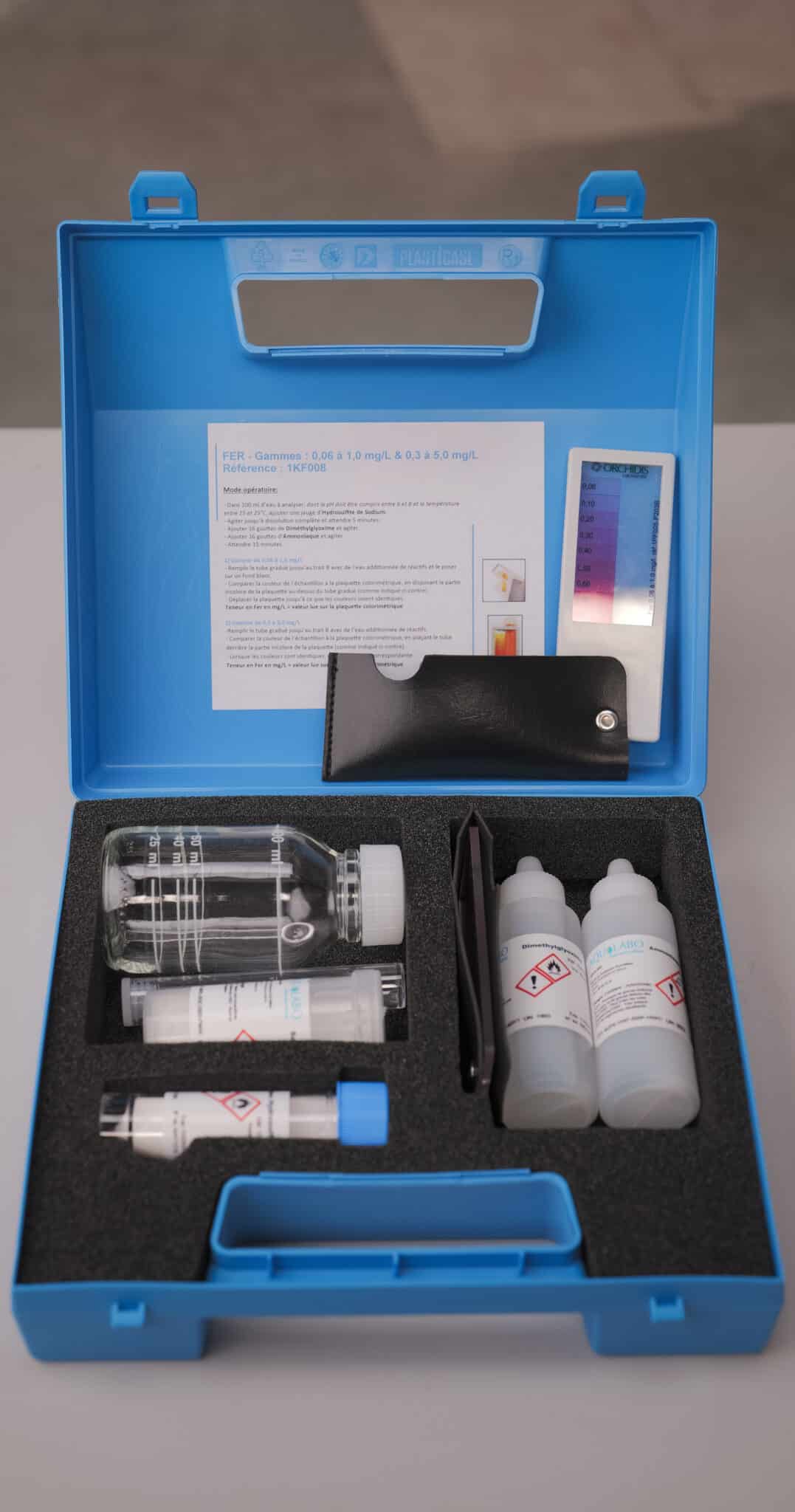
A colorimetric kit is suitable when an estimate needs to be obtained directly in the field. Reagents are added to the sample, then the resulting colour is compared with a scale supplied with the kit.
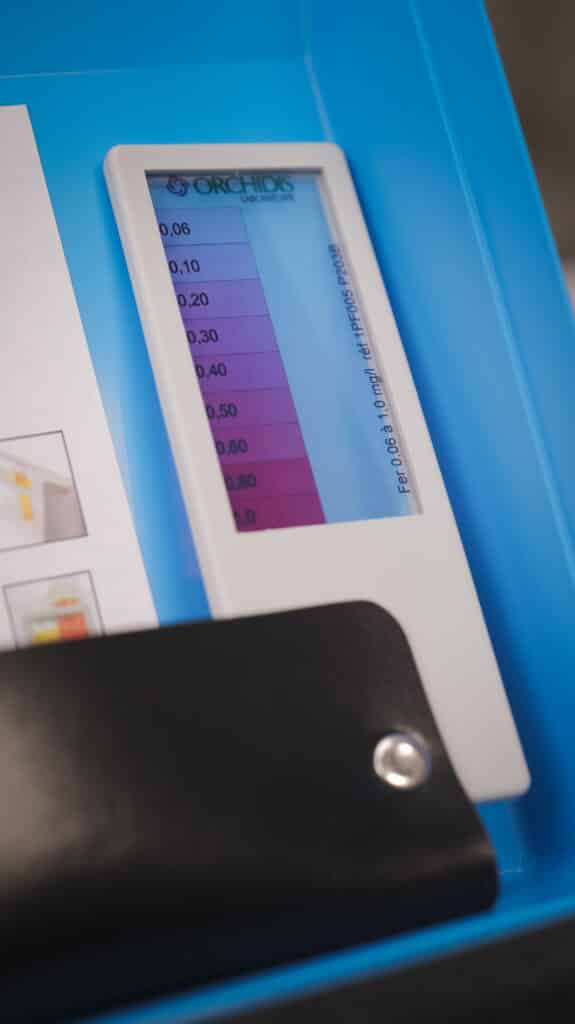
The AQUALABO 1KF008 kit measures Fe²⁺/Fe³⁺ iron over two ranges: from 0.06 to 1 milligram per litre (mg/L) and from 0.3 to 5 mg/L. The scales allow several concentration levels to be read.
This method is suitable for testing after an intervention, comparing several points or carrying out an initial check before an instrumented analysis.
When should a spectrophotometer be used?
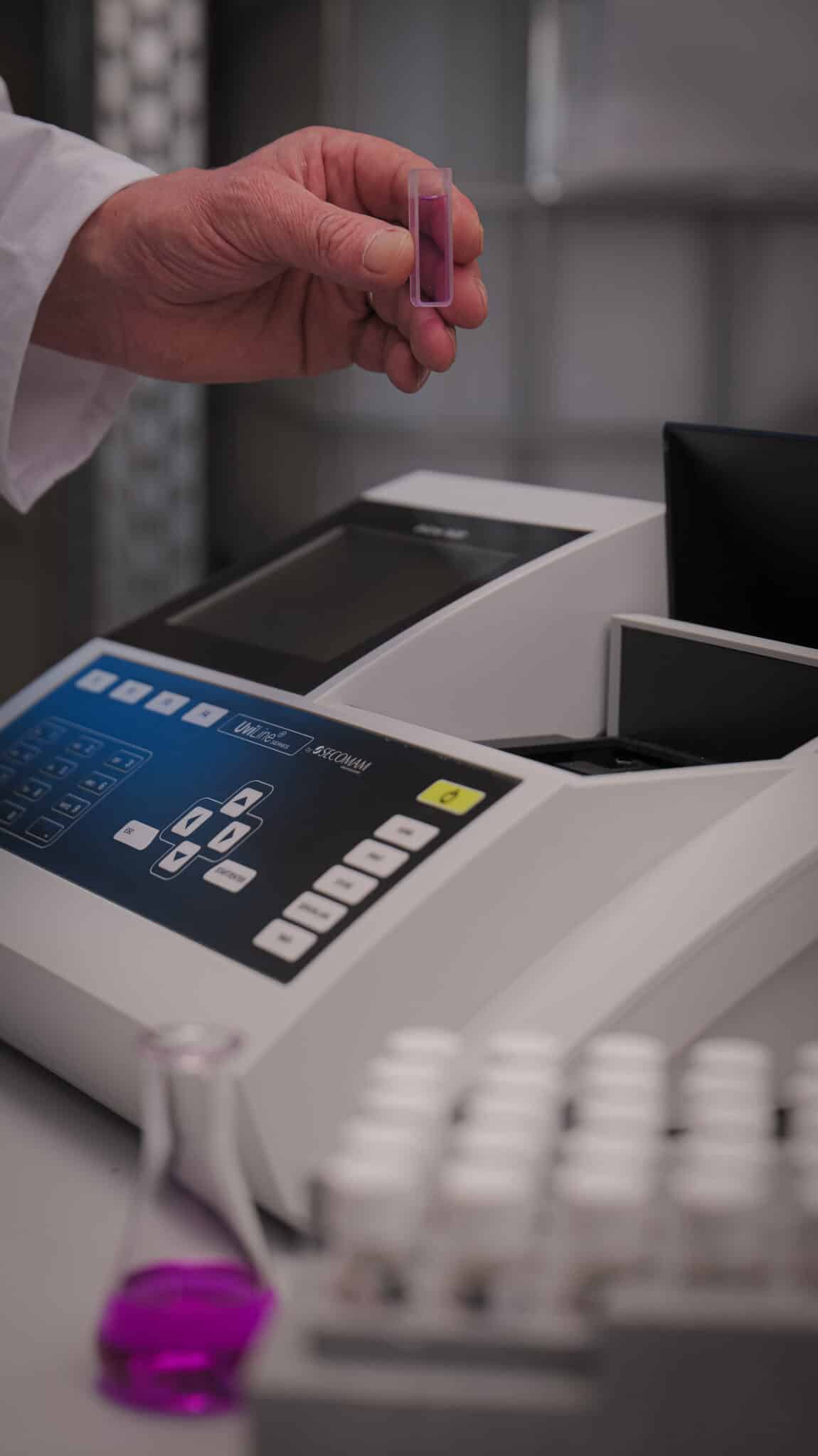
An instrumented colorimetric analysis may be considered when the reading needs to be performed by an instrument rather than by visual comparison. After the reagents are added, the spectrophotometer measures the intensity of the colour and calculates the concentration corresponding to the method used.
UVILINE spectrophotometers can be used with certain reagents (1MS319) for the analysis of iron concentration. This configuration is useful when results need to be recorded, compared across several campaigns or integrated into analytical monitoring. It also reduces reading differences linked to visual comparison.
Spot testing or regular monitoring?
Spot testing responds to a specific situation: coloured water, deposits, recommissioning, intervention on equipment or doubts about the feed water. It documents the condition of the circuit at the time of sampling.
Regular monitoring is used to observe changes over time. Analyses must then be carried out at the same point, using the same method and under comparable conditions.
In which applications is iron testing relevant?
Closed heating circuits
In a closed heating or cooling circuit, iron testing may be carried out during commissioning, after a maintenance operation or when dark water and deposits are observed.
It can also be used to assess the effect of cleaning, partial draining or a change in water treatment by comparing the results obtained before and after the intervention.
Cooling towers and industrial water
In a cooling tower, iron measurement can be included in the checks carried out on circulating water and make-up water. Comparing these two points helps determine whether iron is already present in the feed water or whether it appears during operation.
In industrial installations, testing may be triggered after a shutdown, restart, intervention on a heat exchanger or the appearance of deposits in a pipe. It can also be used to check whether a change in treatment is accompanied by a measurable variation.
Distribution networks and process systems
In a distribution network, iron may be tested when water discolouration, deposits or a change is observed at certain points. Comparing several samples helps determine whether the phenomenon is localised or present over a wider area.
In a process system, analysis may be carried out upstream and downstream of a piece of equipment to identify any change in concentration along the water flow path.
Testing iron in water circuit: choosing the right method
Iron testing must meet a specific need: confirming its presence, quickly estimating its concentration, comparing several points or building a history.
Aqualabo supports operators and water treatment professionals in selecting kits, reagents and instruments suited to the type of circuit and the required level of analysis.