Why monitor chlorides in industrial water?
In an industrial installation, chloride concentration varies depending on the water used, process inputs and, in some circuits, evaporation. An increase may therefore prompt checks of the make-up water, the introduction of a higher-chloride stream or possible saline contamination.
Chlorides are monitored in process water, cooling circuits, make-up water and boiler installations. To interpret the result, the operator compares it with the circuit’s usual values and takes into account the materials used and the operating conditions.
Key points of the article
- Chlorides originate from the feed water, the process or saline inputs. In circuits subject to evaporation, their concentration gradually increases.
- A high concentration increases the risk of certain forms of corrosion, particularly on sensitive metallic equipment.
- Monitoring can be carried out in the field using a drop-count titration kit or by volumetric titration for regular analyses at a fixed workstation.
What does the presence of chlorides in industrial water reveal?
Where do chlorides in water come from?
Chlorides are chloride ions (Cl⁻) dissolved in water. Their concentration is expressed in milligrams per litre (mg/L). They may already be present in the raw water or mains water supplying the site. The process may then introduce additional chlorides, for example through salts, brine or mixing with water containing a higher chloride concentration. Chlorides should not be confused with chlorine used for disinfection.
How should a change in chloride concentration be interpreted?
In installations where some of the water evaporates, chlorides remain in the water and gradually become more concentrated. An increase observed only within the circuit does not have the same origin as a high chloride concentration already present in the feed water.
A rapid increase is more likely to prompt checks for a change in make-up water, the introduction of a new flow, temporary contamination or a change in chemical treatment. A steady increase is more likely to indicate salt concentration within the circuit, provided that no additional chlorides are introduced by the process or water treatment.
Comparing several measurement points helps identify the origin of the change. A measurement at the inlet followed by another further along the installation shows whether the chlorides enter with the feed water or accumulate during the process.
Why can a high chloride concentration cause problems?
Chlorides promote certain forms of corrosion on metallic equipment. Stainless steels are particularly susceptible to localised corrosion, including pitting corrosion. The attack remains concentrated in a small area and can progress while the rest of the surface appears intact.
In a circuit where chloride levels are increasing, this parameter therefore complements checks on heat exchangers, pipework and other exposed equipment. The risk depends in particular on the metal grade, temperature, pH, oxidising conditions and the possible presence of stagnant areas or deposits.
Which installations are concerned?
In a cooling tower, evaporation gradually concentrates salts. In a reverse osmosis or demineralisation unit, measurements taken at several stages can be used to monitor changes in the water throughout the treatment process. In an industrial process, the operator compares the feed water with points located further along the circuit. For boilers and steam systems, the results must be interpreted in relation to the characteristics and requirements specific to the installation.
Chloride monitoring is particularly relevant for:
- cooling towers
- reverse osmosis and demineralization units
- the food and beverage industry
- industrial washing systems
- marine installations and saline water
- boilers and steam systems
How can chlorides be monitored in industrial water?
The choice of method depends on the conditions of use, the expected concentration range and the required level of accuracy. For a rapid check directly on the installation, a drop-count titration kit requires little equipment and is easy to carry. At a fixed workstation, a burette facilitates repeated titrations and allows the sample volume to be adjusted more precisely when concentrations vary.
Both methods can therefore be used on the same site depending on the type of check required.
Requirement | Suitable method |
Spot check in the field | Drop-count titration kit |
Checking a concentration range | Drop-count titration kit |
Several points to check | Drop-count titration kit |
Daily or weekly checks | Burette titration |
Series of analyses at a fixed workstation | Burette titration |
High concentrations requiring adjustment of the sample volume | Burette titration |
Reducing the use of CMR-classified reagents | CMR-free kit or 314C method |
Carrying out a rapid field test
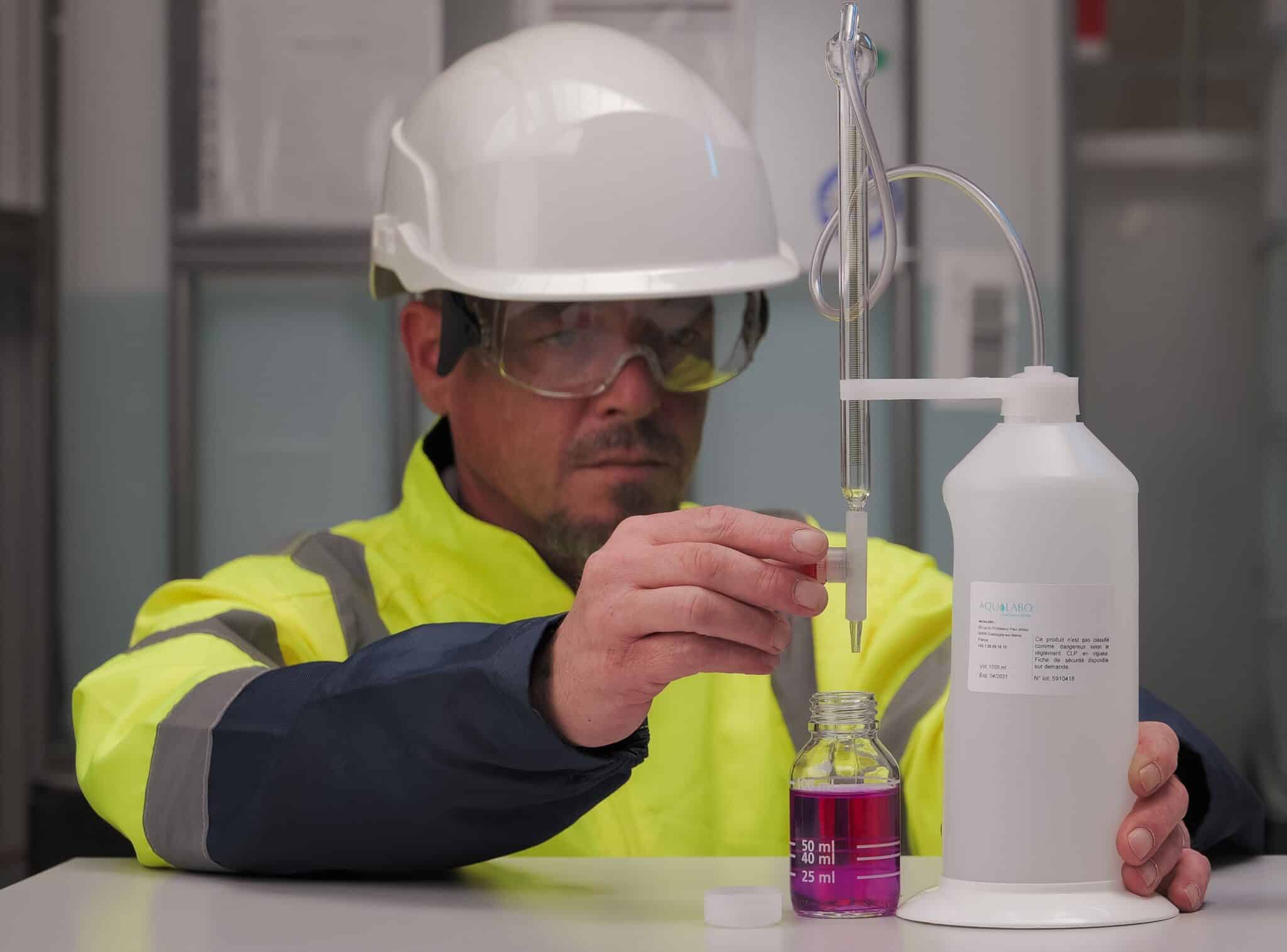
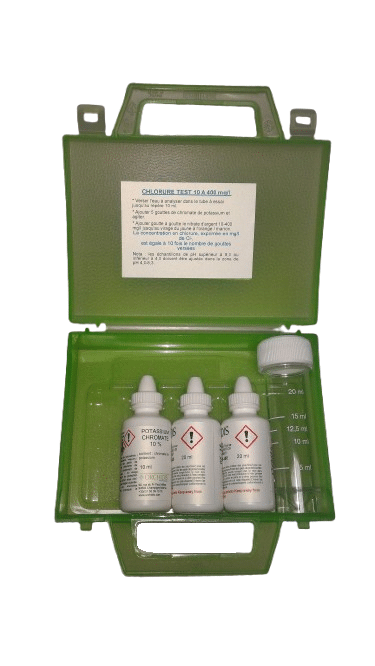
A drop-count titration kit requires little equipment and only a small sample volume. After the indicator is added, the titrant is added drop by drop until the colour changes. The concentration is then calculated from the number of drops.
Within the range considered, Aqualabo offers three measurement ranges: 1KC020 from 2 to 250 mg/L, 1KC105 from 50 to 400 mg/L and 1KC120 from 100 to 250 mg/L.
Carrying out regular checks by volumetric titration
At a fixed analysis station, a burette is better suited to repeated checks and series of analyses. The procedure includes preparing the sample, filling the burette, carrying out the titration and reading the volume of titrant used.
The 314C method uses a chloride titrant solution and a chloride indicator. The standard protocol is based on a 100 mL sample. For higher concentrations, the sample volume is reduced and then made up to 100 mL with demineralised water.
How should the result be read and adjusted depending on the method?
With a drop-count titration kit, the result is calculated from the number of drops added and the factor specified for the relevant reference. The kits considered use equivalents of 2, 4 or 10 mg/L per drop. For example, the 1KC020 distinguishes between two ranges: from 2 to 100 mg/L, the calculation is based on 2 × (number of drops – 1); from 100 to 250 mg/L, it is based on 4 × the number of drops. With a burette, the operator reads the volume of titrant used. For method 314C, the value is expressed in French degrees (°f) and then converted into mg/L of chlorides using a factor of 7.1 mg/L per French degree, according to: 1 °f = 7.1 mg/L Cl⁻.
Are there analytical methods without CMR-classified reagents?
Aqualabo offers CMR-free solutions for both field testing and burette analyses. The 1KC105 and 1KC120 kits use a drop-count titration protocol, while the 314C method is designed for volumetric titration.
This criterion can be taken into account when selecting a method if a site has a hazardous substance substitution policy or wishes to reduce the use of reagents classified as carcinogenic, mutagenic or toxic to reproduction (CMR).

Adapting chloride monitoring to site requirements
Aqualabo supports professionals in water treatment, energy, industry and maintenance for both field testing and regular analyses. Our teams can help you select the measurement range and method best suited to the concentrations encountered in your installation.