Industrial wastewater in Italy: when should online monitoring be used?
For the monitoring of industrial wastewater in Italy, online monitoring becomes relevant when laboratory analyses do not provide sufficient visibility into variations in the discharge. Online monitoring then makes it possible to observe changes between two sampling operations and relate them to site operation.
The decision to instrument a site depends as much on effluent variability as on its hydraulic organisation: which flows are mixed? Where are samples taken? In Italy, this type of monitoring can notably help detect deviations more quickly and secure operations ahead of the controls required under Legislative Decree 152/2006 and, depending on the regime applicable to the installation, its Integrated Environmental Authorisation (Autorizzazione Integrata Ambientale, AIA) or Single Environmental Authorisation (Autorizzazione Unica Ambientale, AUA).
Key points of the article
- Online monitoring is relevant when the characteristics of the discharge change at times that standard sampling cannot document.
- On a site with several discharge points to analyze, the choice of measurement point and parameters directly determines what the measurement can reveal.
- Continuous data help contextualize reference analyses and better target periods requiring particular attention.
When should laboratory analyses be supplemented with online monitoring?
When variations are missed by sampling
A cleaning phase, draining operation or change in production may temporarily alter the discharge without coinciding with the sampling time. Continuous monitoring of the relevant parameter then provides additional insight between two laboratory analyses. The curve shows the start of the peak, its duration and the return to usual conditions. If the same profile reappears, the historical data can then be compared with production data to determine whether the event is isolated or recurring.
When the result arrives too late to explain the event
A sample may be perfectly representative at the time it is taken and still arrive too late to genuinely help teams understand the situation and make decisions. By the time the laboratory result is available, the production phase concerned may have ended several hours or several days earlier.
With a measurement recorded over the same period, teams can go back to the curve and compare it with site operation. A pH drift during cleaning, an increase in conductivity after the arrival of a new flow or a rise in turbidity when a line starts up can guide the first checks. This is not enough to assign a cause, but it prevents teams from having to restart the investigation without clear timeline.
Which discharges justify more advanced instrumentation?
Sites where several process water flows are mixed
On an installation comprising several workshops, different effluents may join a common collector. Their contribution to the final discharge then changes according to the production lines in operation, cleaning sequences or volumes sent to treatment. A measurement taken only on the final discharge highlights a change without making it possible to know where the origin lies or which area of the site is affected.
This requires going back to the hydraulic diagram: water origins, intermediate collectors, mixing points and treatment inlet.
Choosing the measurement point according to the question asked
The best location is therefore not necessarily the final discharge point. When positioned before a treatment stage, it provides more information on the incoming load or on a variation linked to the process.
Defining the parameter that is truly useful for decision-making
A variation does not necessarily require all available parameters to be monitored. The need may be to detect a change in pH, an increase in conductivity, a rise in turbidity or a change in organic load.
If the issue concerns, for example, the mixing of two flows with different characteristics, a parameter capable of distinguishing between these two waters may be more relevant than a complete set of measurements.
How can online monitoring be combined with reference analyses?
Contextualising a non-compliant result
When an analysis reveals a non-compliant or unusual value, the sensor history shows what happened before and after sampling. It is therefore possible to see whether the episode corresponds to a peak lasting a few minutes, a gradual drift or a situation that remained stable for several hours.
This information must be compared with the events recorded on site: line start-up, cleaning, change in production or arrival of a new flow towards treatment.
Maintaining the distinction between monitoring and compliance
The data provided by an online analyser do not replace the controls required for the site. For Italian installations, discharge and monitoring conditions remain those defined by the regulatory framework and the requirements applicable to the site.
Depending on the sector, European Best Available Techniques conclusions, or BAT conclusions, may provide for continuous monitoring of certain parameters and periodic analyses for others.

How can online monitoring be integrated on an industrial site in Italy?
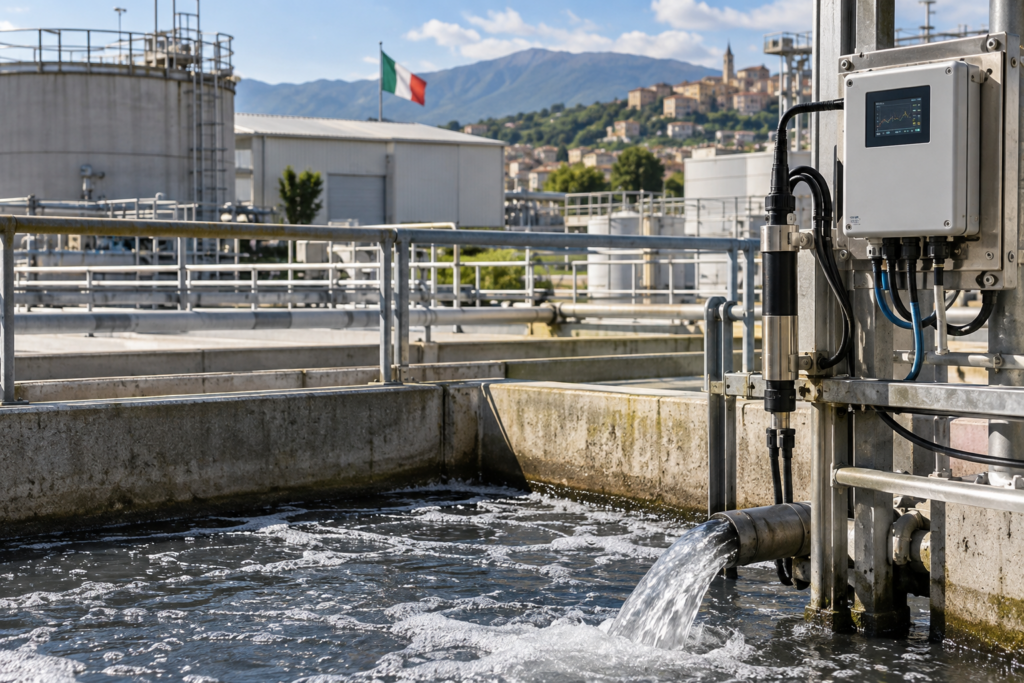
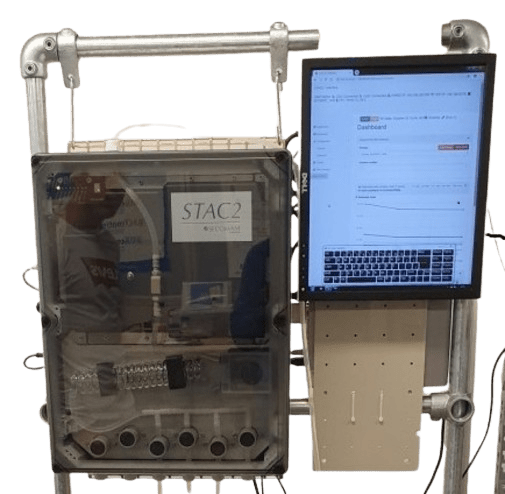
Aqualabo has been supporting industrial operators and water professionals in Italy for several years in the control and monitoring of their effluents. Depending on the characteristics of the site, measurement may rely on a STAC2 UV analyser, potentially complemented by turbidity, total suspended solids (TSS), pH or conductivity sensors. The configuration depends on the flows to be monitored and the controls already in place. Aqualabo can combine online analysis, sensors and data transmission according to the equipment already installed on site.
Focus on Stac2
Aqualabo’s Stac2 uses deconvolution technology developed by Secomam to analyse several parameters simultaneously using UV/Vis spectrophotometry. It can be used in particular to monitor biochemical oxygen demand (BOD), chemical oxygen demand (COD), total organic carbon (TOC), total suspended solids (TSS) and nitrates. Its four measurement channels make it possible to monitor several control points or several parameters in parallel.