Interpreting dissolved oxygen in Scottish salmon farms
Dissolved oxygen measurements in Scottish salmon farms must be interpreted by taking into account environmental conditions and farm operation. A decrease may have different implications depending on its duration, the depth affected, its extent across the cages and the events observed at the same time.
Summer periods require particular attention, especially when rising temperatures coincide with harmful algal blooms. The biomass present, feeding activity and water circulation through the cages also provide useful indications for analysis. The objective is to understand the conditions actually experienced and to trigger the checks or actions defined by the farm.
Why continuously monitor dissolved oxygen in Scottish salmon farms?
An essential parameter for fish welfare
Dissolved oxygen refers to the amount of molecular oxygen present in water. Fish absorb dissolved oxygen through their gills to support respiration. When its availability decreases, their feeding, activity and physiological functions may be affected. The consequences depend on the level reached, the duration of exposure, temperature and the condition of the fish.
The measurement is generally expressed in milligrams per litre (mg/L) or as a percentage of saturation (%). Saturation indicates the proportion of oxygen present compared with the amount the water could contain under the measured conditions. Temperature and salinity must therefore be taken into account during interpretation.
Monitoring that has become essential in Scottish farms
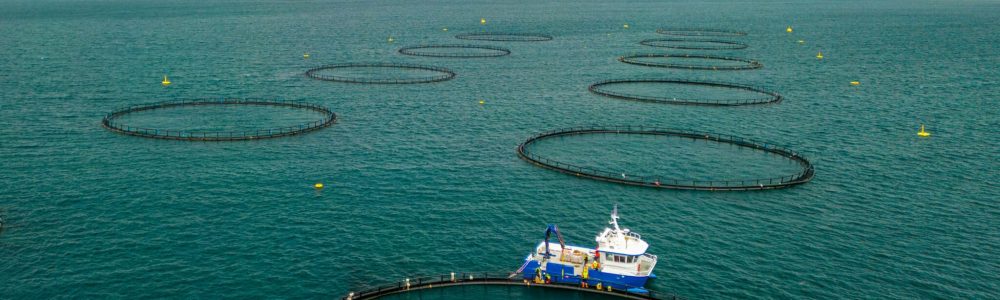
In a marine farm, oxygen concentration varies across the site. Currents, bathymetry, cage layout and net condition influence water renewal around the fish. A measurement taken at a single depth therefore does not always reflect all the conditions experienced by the fish.
In Scotland, oxygen depletion is one of the factors associated with certain summer mortality events. The observed impacts may be greater when low oxygen coincides with a harmful algal bloom or gill disease that reduces fish ability to absorb oxygen
What events can cause a decrease in oxygen?
Temperature and summer stratification
When water temperature increases, its capacity to hold oxygen decreases. At the same time, the physiological conditions of fish change with temperature. A decrease in oxygen recorded during a warm period must therefore be interpreted with greater caution than the same value measured in colder water.
In summer, the water column can also divide into layers with different temperatures. This stratification may be accompanied by oxygen differences between the surface and deeper levels. A probe installed at a fixed depth then describes only part of the conditions encountered in the cage. Comparing several depths makes it possible to identify a less oxygenated zone or a vertical change that would remain invisible with a single measurement point.
Harmful algal blooms
Harmful algal blooms are among the environmental events encountered in Scottish farming areas. Their development near cages, or their transport towards the site by currents, can quickly affect fish. Fish may be exposed to toxins, irritation or gill obstruction. High-biomass blooms can also contribute to a decrease in oxygen, particularly during decomposition.
An unusual decrease in oxygen may therefore be an environmental signal that requires investigation. It may be associated with a bloom, but also with the arrival at the site of a water mass that is already oxygen-depleted. However, it is not sufficient either to confirm the presence of a bloom or to identify the species involved. Oxygen data should therefore be compared with observations made on the cages and with phytoplankton monitoring systems.
Variations in biomass and feeding
The quantity of fish present in a cage influences oxygen consumption within the farming volume. This relationship also depends on water exchange, cage position, currents and net condition.
Feeding periods must also be taken into account. Fish activity and oxygen consumption may change around feeding phases. A decrease observed at these times should be assessed in relation to the ration distributed, the biomass and the behaviour of the stock.
The same oxygen level does not therefore necessarily have the same meaning in a heavily stocked cage, in a less well-flushed area or during a period of increased fish activity.
How can data be used to respond quickly?
Defining thresholds adapted to farm operation
An alert threshold must be defined according to the characteristics of the aquaculture farm. The selected values depend in particular on the site, temperature, fish being farmed, monitored depths and the company’s technical and health procedures.
The settings may include several levels. A first level draws attention to a change that requires verification. A second level corresponds to a degraded situation requiring enhanced monitoring. The final level triggers the actions defined by the farm.
This organisation should prevent an alert from being displayed without associated instructions. For each level, the farm must specify the selected value, the alert recipients and the expected checks.
Detecting trends before fish are affected
A decrease in oxygen does not always immediately cause a visible change in fish behaviour. However, the curve may show a gradual decrease, recurring episodes at certain times or an unusual difference between several cages or depths.
The team must then determine whether the phenomenon concerns a single measurement point or a wider area. A decrease limited to one cage may direct checks towards a localised phenomenon. A change observed in several cages may more strongly indicate a change in environmental conditions across the site.
An alert must be assessed alongside events observed on the farm: feeding in progress, a change in current, temperature rise, technical intervention, unusual fish behaviour or an environmental warning. This contextualisation helps avoid interpreting every variation as an actual deterioration in the environment.
Choosing between fixed measurement and spot checks
Depending on the farm’s organisation, monitoring may rely on sensors installed at fixed points and connected to a transmitter or to a system compatible with the existing infrastructure. This configuration is suitable when data must be recorded over time and associated with alert thresholds.
Portable instruments can complement the system to compare several cages, check different depths or carry out spot checks on other parameters. The choice depends on the number of points to be monitored, the frequency of checks and the method used to retrieve the data.
Aqualabo offers, in particular, the OPTOD sensor for fixed dissolved oxygen measurement, as well as the NEON Open and ODEON portable instruments for on-site spot checks.
Using data to secure production
Dissolved oxygen measurement must address clearly identified situations on the aquaculture farm. The selected system must provide information that can be used directly by the teams. This requires positioning sensors in the relevant areas and at the relevant depths, linking alarms to precise instructions and planning maintenance suited to marine conditions.
Aqualabo supports operators and aquaculture managers in choosing instruments suited to fixed or spot dissolved oxygen measurement, according to the control points and the conditions encountered on site.