Water buffering capacity: understanding its role in pH stability
In industrial installations using water, pH stability directly affects process reliability and equipment service life. Cooling circuits, boilers, wastewater treatment plants: when pH changes uncontrollably, chemical treatments lose effectiveness and the risks of corrosion or scaling increase.
This stability largely depends on water buffering capacity, meaning its ability to limit pH variations when acidic or alkaline inputs are generated by the process. In this article, we explain the role of buffering capacity in pH stability, the possible causes of unstable pH and the methods used to measure alkalinity in the field.
What is water buffering capacity?
Definition
Water buffering capacity is mainly related to total alkalinity, which reflects the presence of dissolved alkaline species in water, mainly bicarbonates (HCO₃⁻), carbonates (CO₃²⁻) and, in more alkaline waters, hydroxides (OH⁻). These ions act as chemical buffers by neutralizing acidic or alkaline inputs before they affect pH.
Water with very low alkalinity may show strong pH variation after the addition of only a few milligrams of acid or base, whereas highly alkaline water will resist these disturbances much more effectively.
Total alkalinity is expressed in milligrams per litre as calcium carbonate equivalent (mg/L CaCO₃). A high total alkalinity indicates strong buffering capacity: pH then becomes more stable and more resistant to external disturbances.
Why water buffering capacity is important in processes
In an industrial environment, water is exposed to acidic inputs, biological reactions, dilution and temperature fluctuations. Without sufficient buffering capacity, even a minor imbalance may cause a sudden drop or rise in pH. Yet many water treatment processes are sensitive to pH: chemical reactions, bacterial activity, coagulation and disinfection. Suitable total alkalinity stabilizes the whole system and helps maintain stable operating conditions.
Why is your pH fluctuating?
In industrial installations, pH fluctuations may result from multiple factors, including acidic effluents, biological activity, water dilution or chemical inputs linked to the process. Carbon dioxide (CO₂) exchange with air or biological reactions can also alter the carbonate balance of water and influence pH stability.
These variations may appear gradually or suddenly depending on water composition and the ongoing chemical reactions within the installation. Insufficient buffering capacity amplifies these imbalances instead of absorbing them.
Industrial water, process and cooling systems
At industrial sites, operators sometimes observe pH drift during production phases, shutdowns or when make-up water is added to circuits.
In cooling circuits, evaporation can concentrate certain dissolved salts, while water additions modify the chemical balance of the circuit. For maintenance technicians or process managers, these changes may result in frequent adjustments of treatment chemicals.
When water buffering capacity is insufficient, these adjustments become more sensitive and small doses of corrective products may cause major pH deviations.
Boiler water and closed-loop systems
In industrial or collective boiler rooms, installers and maintenance technicians regularly monitor water pH to prevent corrosion or scaling.
pH variations may occur during circuit filling, the addition of treatment chemicals or after certain maintenance operations. In closed-loop heating systems, weakly buffered water reacts more strongly to these changes.
For plumbers and boiler room operators in buildings, this may result in difficulty stabilizing pH despite the corrections applied. In this context, analysing alkalinity and water buffering capacity helps better understand these fluctuations.
Wastewater treatment plants
In wastewater treatment plants, operators closely monitor basin pH. Microorganism activity depends on relatively stable chemical conditions. Under variable pollution loads or industrial effluent inputs, biological reactions may produce acidic or alkaline compounds.
When water buffering capacity is low, these variations may become more rapid and disrupt certain stages of biological treatment. Operators must then intervene to restore a balance compatible with proper plant operation.
Other sectors: drinking water and aquaculture
In other contexts, such as drinking water production or aquaculture installations, pH balance influences the chemical and biological reactions occurring in water.
Treatment processes, exchanges with the environment and biological activity may modify the composition of the medium. Buffering capacity limits the extent of these instabilities. When it decreases, water becomes more sensitive to external inputs and pH fluctuations may occur more rapidly.
Indicative alkalinity ranges in water treatment processes
Expected alkalinity levels vary depending on the treatment process. The following table presents a few indicative ranges observed in different contexts.
Process / Water type | Recommended alkalinity (mg/L CaCO₃) | Role of buffering capacity |
Domestic wastewater (influent) | 100 – 300 | Maintains stable pH conditions for biological treatment |
Activated sludge | 80 – 150 | Stabilizes microbial activity in the biological reactor |
Nitrification | ≥ 7 × [mg/L NH₄-N] | Compensates for acidification caused by ammonia oxidation |
Denitrification | ≥ 75 | Maintains stable conditions for denitrifying bacteria |
Anaerobic digestion | 2000 – 5000 (total alkalinity) | Buffers volatile fatty acids produced during fermentation |
These values are indicative and may vary depending on processes and operating conditions.
How can water buffering capacity be measured?
pH measurements make it possible to observe variations in the medium. When fluctuations are detected, alkalinity analysis helps assess water buffering capacity and better understand the origin of these variations.
In practice, total alkalinity below 50 mg/L CaCO₃ (approximately 5 °f) indicates very low buffering capacity: the water has little resistance to pH variation and requires close attention whenever treatment chemicals are added. Between 50 and 150 mg/L (5 to 15 °f), buffering capacity is moderate, sufficient for most heating circuits, but it should be monitored regularly in biological processes such as wastewater treatment plants. Above 150 mg/L (15 °f), water shows good buffering capacity, although excessively high values may in some cases promote scaling of equipment, especially in high-pressure boilers where alkalinity must instead remain very low.
These reference points help assess whether total alkalinity falls within an acceptable range and make it possible to adjust chemical corrections if necessary. When alkalinity becomes insufficient relative to operating targets, often around 80 to 150 mg/L expressed as CaCO₃ depending on the process, operators may add certain alkaline substances to restore water buffering capacity.
Spot checks using analysis kits
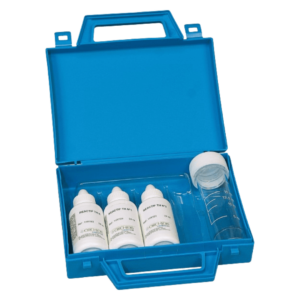
Analysis kits allow spot checks to be carried out directly in the field. These methods generally rely on drop-count titration, where the gradual addition of reagent causes a colour change in the sample at the equivalence point. The number of drops needed to reach this colour change corresponds to the alkalinity concentration.
Regular industrial monitoring by burette titration
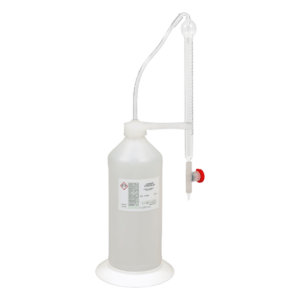
In installations requiring frequent analyses, burette titration enables precise and reproducible measurements. The gradual addition of titrant solution to the sample makes it possible to determine the concentration of the parameter being analysed.
P alkalinity and total alkalinity measurement by burette
Alkalinity measurement consists of gradually adding an acidic titrant solution to the sample until the equivalence point is reached, identified by a colour change.
With the P alkalinity indicator (phenolphthalein), the solution changes from pink to colourless. For total alkalinity, methyl orange changes from yellow to orange, or from blue-green to pale pink depending on the reagent used.
P alkalinity (phenolphthalein), also called partial alkalinity, corresponds to the neutralization of hydroxide ions (OH⁻) and the conversion of carbonate ions (CO₃²⁻) into bicarbonate ions (HCO₃⁻) around pH 8.3. P alkalinity therefore highlights the presence of hydroxides and carbonates in water.
Total alkalinity (methyl orange) also measures bicarbonates and therefore corresponds to the total alkalinity of the water.
Aqualabo, solutions for water quality analysis and monitoring
For boiler room operators, maintenance technicians, process managers or treatment plant operators, joint observation of pH and alkalinity helps anticipate certain types of drift, adapt treatments and maintain operating conditions compatible with installation requirements.
Aqualabo supports professionals with measurement and analysis solutions adapted to field constraints and to different operating environments.
Contact our team to identify the measurement methods and equipment best suited to your installations.