Sulfite Analysis: Corrosion Control and Process Monitoring
Sulfite analysis is a key element in monitoring installations that use treated water, particularly in thermal circuits and certain industrial processes.
Sulfites, present as SO₃²⁻ ions (sulfite ions), are commonly used to scavenge residual dissolved oxygen and mitigate oxygen-induced pitting. Their concentration must be precisely controlled to ensure treatment efficiency without generating undesirable effects. This article outlines the challenges associated with sulfites, their fields of application, and the analytical solutions suited to operational control.
Why Measure Sulfites?
Measuring sulfites is part of a broader strategy for controlling the chemical treatment of treated water circuits. It helps verify that operating conditions remain consistent with equipment protection objectives and system stability requirements.
Removal of Dissolved Oxygen in Circuits
One of the main roles of sulfites is to reduce residual dissolved oxygen present in water after thermal deaeration. Sulfites act as chemical deoxygenating agents, reacting with residual oxygen to form sulfates, thereby inhibiting oxidative corrosion. Even after this step, traces of oxygen may remain and trigger oxidation reactions upon contact with metal surfaces. These reactions notably promote pitting corrosion, which is particularly aggressive toward equipment.
Recommended concentrations, generally expressed in mg/L of sulfites (SO₃²⁻) or mg/L Na₂SO₃ (sodium sulfite), vary depending on installation configuration and operating conditions (boiler pressure, blowdown rate, type of treatment ; sulfite alone versus catalyzed treatment). Sulfite concentration must be adapted to the boiler operating regime and the efficiency of the deaerator.
Sulfites and Corrosion Prevention in Installations
Sulfites indirectly contribute to protecting metal surfaces by maintaining a low-oxygen environment, a necessary condition for passivation and maintenance of the protective magnetite film formed in boiler circuits. This layer acts as a barrier, limiting exchanges with the surrounding environment and slowing corrosion processes.
However, the presence of this protection depends on controlled chemical conditions. An unsuitable sulfite concentration may compromise the formation or stability of this protective layer.
Sulfite analysis therefore serves as an operational indicator of proper chemical treatment performance. It forms part of a comprehensive monitoring strategy adapted to various treated water circuit operating contexts.
Application Areas for Sulfite Monitoring
Sulfites are used in several industrial sectors where oxidation control and residual concentration monitoring are required. Their analytical monitoring supports various applications related to both thermal circuits and water treatment.
Industrial Processes Using Steam
Steam circuits are widely used as process utilities in many industrial sectors, including food processing, healthcare, pharmaceuticals, and certain technical services. Steam is involved in operations such as heating, raw material transformation, cleaning, or equipment sterilization. In these contexts, boiler water quality directly affects installation reliability and production continuity.
Sulfite monitoring is part of the control of treatments applied to boilers and steam distribution networks. It supports corrosion control management and helps maintain chemical conditions suited to the specific constraints of each industrial site.
Textile and Paper Bleaching
In textile and paper industries, sulfites are primarily used as antichlors to neutralize residual oxidizing agents or as bleaching auxiliaries. These applications rely on specific chemical properties of sulfur compounds and require precise control of implemented concentrations.
Analytical monitoring of sulfites supports process control and compliance with applicable operational requirements. The selected analytical method must be compatible with the nature of the matrices analyzed and with the operating conditions specific to each application, in order to provide actionable industrial results.
Dechlorination of Water and Effluents
In wastewater and industrial effluent treatment, sodium bisulfite (NaHSO₃) or sodium metabisulfite (Na₂S₂O₅) are very commonly used to neutralize residual chlorine present after certain disinfection stages. This step occurs prior to discharge into the natural environment or water reuse, in order to limit chlorine effects on downstream processes and receiving environments.
Sulfite monitoring is integrated into treatment control operations applied to water. It contributes to evaluating treatment process performance and monitoring the quality of discharged water, in accordance with applicable wastewater regulations.
How Does Sulfite Analysis Work?
Sulfite analysis is based on chemical methods used to quantify the concentration of SO₃²⁻ ions (sulfite ions) in water. These methods must provide a balance between analytical accuracy, ease of implementation, and compatibility with field constraints.
Principle of Titration Applied to Sulfites
Titration is an analytical method based on an oxidation-reduction (redox) titration involving the oxidation of sulfite by iodine. The volume of reagent required to reach the equivalence point determines the sulfite concentration. This method is widely used for its robustness and reproducibility. It remains a reference technique for chemical treatment control in many industrial contexts.
Drop-Count Bottle Titration Method
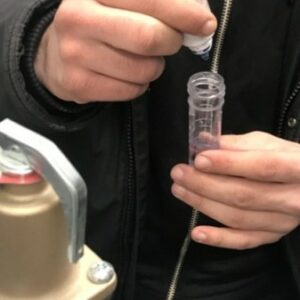
Drop-count bottle titration is well suited to field analysis. It allows measurements to be carried out directly on site without heavy instrumentation. The protocol is simple and compatible with regular use by operating teams.
Integration into Process Monitoring
Results obtained from sulfite analysis are used in combination with other water control parameters. They are integrated into a global process monitoring strategy that links chemical treatment, operating conditions, and site-specific constraints.
Our AQUALABO Solutions
Aqualabo develops analytical solutions designed to meet field requirements and the needs of industrial operators. The kits offered ensure reliable sulfite monitoring in various application contexts.
Sulfite Analysis by Titration
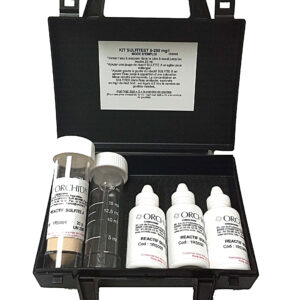
The Sulfite Kit 1KS003 is based on a simple and efficient drop-count titration method. It allows sulfite concentration to be determined directly on site, without complex equipment, making it ideal for industrial environments and routine checks. Its precision ensures reliable results in just a few minutes.
Its use is particularly intuitive: pour 20 mL of sample, add reagent A, then titrate drop by drop with reagent B until a permanent blue-violet color appears. Colorimetric endpoint (starch-iodine complex).
Range: 5 to 250 mg/L Na₂SO₃ (sodium sulfite) – Accuracy: 1 drop = 5 mg/L Na₂SO₃
Range: 3 to 159 mg/L SO₃²⁻ (sulfite ions) – Conversion factor 0.6352
Complementary solutions: Burette titration
Sulfite titration methods using a burette are also available in our catalog. They offer extended titrant storage capacity, increasing throughput and the number of tests performed. This method enables high-precision titration, particularly in industrial environments.

Other Kits and Reagents for Water Monitoring
Aqualabo also offers a wide range of kits and reagents dedicated to the analysis of physico-chemical water parameters. These solutions support a consistent and structured approach to water quality monitoring, aligned with installation requirements.

Sulfite Analysis and Operational Monitoring of Installations
Sulfite analysis is integrated into the monitoring of chemical treatments applied to treated water circuits and industrial processes. By providing reliable and actionable field measurements, it supports the control of operating conditions and the protection of installations in various contexts.
To learn more about our solutions or request a personalized quotation, contact our team today via our contact form